

GOLDBECK: LEARNING CURVES AND RESPONSIBILITY AS WE GROW
WHAT CULTURE MEANS TO US
Christoph Strömer talks with Hans-Jörg Frieauff and Marcus-Friedrich Wattenberg about culture as a living system of values and decision-making: about family members and executives as stewards of culture, and the complementary role of Human Resources (HR); about East Westphalia and Europe, personal responsibility and rules, lessons learned in the world of Mergers & Acquisitions (M&A)—and whether culture is a stylistic device or the spirit that holds everything together.
PEOPLE HERE KNOW EXACTLY WHAT THEY STAND FOR.
It doesn’t start with a strategy. Nor does it start with international expansion. It starts with a place—and a mindset. GOLDBECK is “a company that is quintessentially from Ummeln,” they say in the conversation: Ummeln, a district of Bielefeld, then East Westphalia, then Germany—and for several years now, increasingly Europe. This heritage isn’t folklore. It’s part of the present. And it explains why growth here has always been understood not just as an economic challenge, but as a cultural one, too.
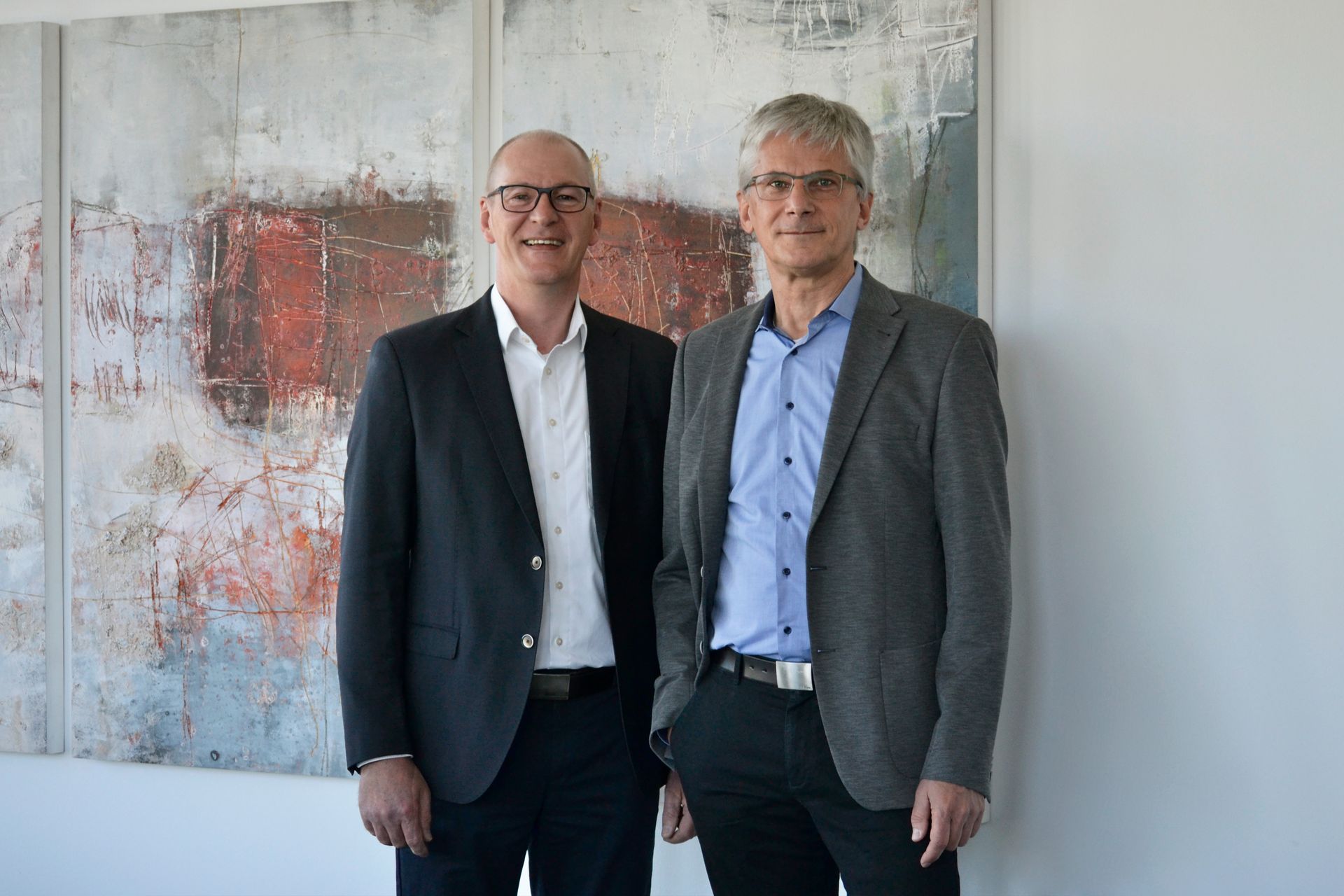
Christoph Strömer: If you compare a company’s culture to a person’s identity, how would you describe the person that is GOLDBECK—in terms of character, attitude and motivations?
Frieauff: Definitely curious and open to new things. Bold. Constantly improving and never satisfied.
Wattenberg: Or “rarely satisfied”—“never satisfied” is wrong. Rarely satisfied.
Rarely satisfied—that sounds like energy. But also like pressure. What do you mean by that?
Frieauff: With a passion for innovation, a focus on results and a commitment to personal responsibility. Although—that begs the question of whether that’s still true today. It certainly was a few years ago.
Wattenberg: People used to take more personal responsibility—across the company as a whole. I think that’s still there, but it’s distributed differently. It’s more pronounced in our core business than in central departments, because those have grown. The further I get from day-to-day operations, the less pronounced it is.
One line that stays with you: personal responsibility hasn’t disappeared—but it has been redistributed, and perhaps changed too. Not as a failure, but as a side effect of growth.
So the GOLDBECK employee likes to optimize things—what exactly does that mean, and how has it evolved as the company has grown?
Wattenberg: Yes, that’s an important characteristic—sometimes in the sense of: “There must be a faster, easier way to do this.” Or: “Can we please not make this so complicated?”
Frieauff: This passion for technical innovation—and for doing it yourself. Not, “I’ll just buy it or ask a supplier.” Instead: “I want to understand it myself and do it myself.” That sets us apart from many in the construction industry.
“Doing it yourself and looking for something better” was a strength for a long time—and became a question as the company grew. A pattern emerges: “doing it yourself” is part of our cultural DNA—and also a risk when it comes to growth.
Frieauff: As long as you’re a manageable-sized company, doing things yourself often gets better results. You don’t spend ages tinkering with solutions; you develop them to fit—and in the end, it’s better when you do it yourself.
And today?
Frieauff: When the scope of performance expands and you start doing more and more things yourself, you end up developing things in-house in too many areas. Then the effort involved in orchestration and coordination becomes greater than the added value. Good off-the-shelf solutions have emerged elsewhere—but we haven’t practiced adopting and applying them. We’re learning now—sometimes the hard way, sometimes with real benefits.
So it’s a question of maturity: not lowering standards, but finding solutions in a different way?
Frieauff: Yes. It’s a demanding process.
As growth increases complexity, rules and bureaucracy seem inevitable.
What has this “person, GOLDBECK” had to learn over the years to remain capable of acting in response to external influences and internal developments—and what, perhaps, has it had to unlearn?
Wattenberg: A great deal. We’ve had to learn to be more precise in some areas. To give ourselves more rules, even if we don’t like it. The more people there are, the wider the range. The centrifugal forces get stronger. An organization that grows tenfold in ten or fifteen years faces a problem: what used to work informally eventually stops working informally.
GROWTH ISN’T THE ONLY THING THAT REQUIRES RULES—SO DOES THE WORLD.
Wattenberg: Regulations have changed: documentation requirements, legal rules, things that didn’t exist 15 years ago. We had to become more organized to manage our size.
How does a culture rooted in personal responsibility respond to bureaucracy?
Frieauff: Growth is the biggest challenge for culture. Because then you need top-down as well as bottom-up—or the other way around, depending on where you’re starting from. You need rules. You create bureaucracy.
Culture happens—whether you want it to or not. At this point, the conversation turns from describing culture to exploring its roots.
What does culture mean to you—in practical terms?
Wattenberg: If you asked people here in the company, I think 90% would immediately be able to name our values: humanity, a sense of responsibility, commitment, pioneering spirit. They’d have those right away.
My impression is that at GOLDBECK, the values aren’t marketing—they’re something that has grown deep roots. And you have stories to go with them: actions, practices.
Wattenberg: Ortwin Goldbeck first put the values in writing in 1990. Before that, he, his managers and employees simply lived them. Since then, we’ve regularly reviewed them with employees, but fundamentally they’ve stayed the same. Decentralization, for example, was already a principle back then. It requires people on the ground to be willing to take responsibility, just as it does during growth. And that’s how we’ve continued to develop it. It was never just about putting things in writing.
Frieauff: You can tell a story about every value. Pioneering spirit, for example: Hildegard Goldbeck guaranteed a loan with her teacher’s salary so that Ortwin could start his own business.
Something important becomes clear here: values aren’t definitions; they’re reality told through stories. And culture is the system that keeps those stories alive.
BEHAVIOR IS VISIBLE—CULTURE WORKS BENEATH IT
When someone new joins the company, what do they notice first? Processes? Onboarding?
Frieauff: If you talk to people who’ve been here for four months, they don’t say, “You’re doing a really professional job with onboarding.” That would actually be a good answer. Instead, they say, “Wow, it’s great here, everyone’s friendly, everyone helps me, they show me everything.” There’s an emotional component—as well as the professional one. And I hear that in so many places. That’s special.
Wattenberg: We make an effort for our people. They repay us with loyalty.
Loyalty as an outcome, not an expectation?
Frieauff: Yes—and it’s different from what you’d probably see in a publicly traded company. The family’s approachability and visibility, and the way they demonstrate and live the values, inspire loyalty well beyond the norm.
Wattenberg: Treating people well is important, but that alone isn’t enough. We want to be professional, get things moving and have a pioneering spirit. We’re not a charity. And if it really isn’t working out, it’s humane and respectful to say: Maybe GOLDBECK isn’t the right employer for you. We hold up a mirror to one another.
Frieauff: And there’s a cascade: employee reviews, annual dialogues, talent dialogues, potential assessments—the topics discussed keep referring back to the culture and values we live by. Not as a slogan, but as something important that matters here and now.
Growth as transition—not scaling. At this point, the lived East Westphalian identity raises an open question: How do you Europeanize a company?
You’ve both talked about how things change as the company grows, perhaps as a transition from A to B. What does a company learn in these phases?
Wattenberg: Growth isn’t simply a matter of scaling. It’s a learning process. What worked before suddenly stops working—or works differently.
Frieauff: We’re a “true Ummeln company”—Bielefeld at heart, East Westphalian in a broader sense, and German in an even broader one. We grew and became successful in this environment, with a strong sense of who we are. As we become more European, employees realize—or should realize—that this German, “Ummeln,” East Westphalian outlook can’t simply be transplanted to Poland, the UK, Denmark or France. Each has a different national culture. If I want my company culture and German culture to work in another national culture, I have to change. And that need to change—and even the ability to do so—can overwhelm many people, not just employees but managers too.
Wattenberg: The challenge we face in the opposite direction is making it clear that this isn’t a matter of direct democracy. Trust and personal responsibility cut both ways. Reaching out to someone doesn’t mean they can do whatever they want.
Frieauff: We shaped the culture very much from the bottom up. But beyond a certain size, we need top-down leadership, more visibly than before. And we can feel how many people are unsettled by having a top-down directive now—in addition to bottom-up freedom and responsibility.
Wattenberg: In decentralized project work, personal responsibility comes first. Every top-down directive—even down to telling people exactly how much they’re allowed to spend per person on a party—is seen as interference with the entrepreneurial freedom of the people on the ground.
This is where culture becomes tangible amid growth—not as harmony, but as a point of tension between freedom and leadership that needs to be discussed and worked through.
You’ve said that growth forces you to introduce rules. At the same time, expertise comes in from outside. How do you make that work culturally?
Wattenberg: It’s easier to shape people who join us straight from school or university and get their first work experience here. Bringing in experienced managers can sometimes be harder than bringing in young graduates. They bring a culture with them that they’ve acquired over 10, 15 or even 20 years. And it’s the same with M&A: a company comes with its own culture.
My feeling is that we still have that resourceful, proud Ummeln native—but these days, it’s no longer “95% speak German,” but perhaps only 60%. Who will shape the new image, the new identity?
Wattenberg: I’d start with the family: Uwe Goldbeck, shaped more by Bielefeld, and Hendrik Goldbeck, the cosmopolitan. I’m more on the Ummeln side myself. And our globetrotter Hans is always reminding us that we need to understand others.
So do you cultivate your international growth process through a productive tension between people?
Wattenberg: Yes. These personalities are embodied by the owners. “Preserver” and “innovator” don’t really do them justice, but to put it in stark terms: the two brothers at the helm balance each other out. And the same is true elsewhere. A lot depends on dialogue and a willingness to understand. Hans Frieauff has contributed a great deal and made us aware that the French, our English, Danish and Polish colleagues all think differently. At the same time, there are rules: overall management is based in Bielefeld.
Frieauff: The advantage is that we’re aware of this—and treat each other with respect. And when I look at France: We acquired the French company seven years ago—and all the executives are still there. Every single one! That means both sides must have done something right. We open ourselves up to Ummeln—and Ummeln opens itself up to Avignon. And today, we make our contact with European managing directors visible to the wider GOLDBECK community. This appreciation and openness to other national cultures—we make that way of life and that appreciation visible. And what the new GOLDBECK employee will be like in a few years, once we’ve become more European—that remains to be seen.
Here, a sentence emerges that feels like a cliffhanger: the identity isn’t complete. It’s still taking shape.
“MORE GARDENING” — CULTURE WORK IN A COMPLEX WORLD
Do you share the idea of a cultural genotype that provides direction, while the phenotype is free to change? Or do you need to cultivate and combine new things—even at the risk of losing what’s familiar?
Frieauff: Yes. And I’ll pick up on your image: we need to be more deliberate about tending the garden. In the past, perhaps a Christmas speech was enough; Ortwin Goldbeck would walk down the hall and talk to people in person. Today, we have to garden more professionally—through HR touchpoints, through values that are deliberately brought to life in HR processes. The bigger and more diverse we become, the more we need to do. And as complexity increases, so does the complexity of tending the culture. Who does it? How do you know whether you need hedge clippers or a chainsaw?
Wattenberg: Whew, that’s a difficult question. Or do I sometimes really need to make fine, careful adjustments with the pruning shears?
Can this kind of cultivation be delegated?
Wattenberg: Partly. Skills development can be delegated: practical tools, training and development for executives. And the complexity also led to changes in leadership teams: some didn’t want to—or couldn’t—make the journey and reached their limits. And you have to ask yourself: Am I still the right person? Am I up to all this?
Frieauff: HR isn’t responsible for cultivating the culture—that’s not its job. But developing and providing methods so that an ordinary manager can cultivate the culture without undue effort—that absolutely is HR’s job. HR has tried to introduce consistent methods and raise awareness. That’s why we’re better than we were.
Wattenberg: I’d put it differently: the family and us executives are stewards of culture; HR enables culture and builds skills. That’s what the GOLDBECK Campus is for.
Culture in M&A: lessons learned, limits, learning curves. Now we get down to specifics. And this is exactly where Cultural Due Diligence suddenly becomes not “nice to have,” but essential knowledge for survival.
From the outset, were you alert to cultural issues when making acquisitions?
Wattenberg: No. We learned an expensive lesson the first time around. We botched the acquisition.
What was the mistake?
Wattenberg: We were naïve in our assessment. We had no contact with the second level of management. We believed too much of what we were told. We tried too hard to impose our own way of doing things. We got it wrong—not as an accusation, but as a shared mistake. Fortunately, it was one of our first acquisitions—and one of our smallest by today’s standards. And that’s exactly why we now take a close, very deliberate look at culture: getting to know companies from the inside, understanding their culture, and spending time on site.
Frieauff: There was a setback—but in the end, it was a success, too. We learned where the limits are. In the first case, we were too dominant and it failed. The next limit involved a large company in France: there, we did the opposite—we were too accommodating. National culture plays a particularly important role in a German-French context. We were incredibly cautious—and learned from that again. With the Danish company, we got it pretty much right: not too dominant, respectful of cultural differences and family culture—but also clear about what we want and what we can do.
Here’s the line you could put up on the wall in post-merger teams: not dominance—not submission—but consciously navigating between respect and direction.
NATIONAL CULTURE + COMPANY CULTURE + DOMINANCE: THE INVISIBLE THIRD LEVEL
Frieauff: If both companies are from the same country, you have a company culture to analyze and align. But if you acquire a company from another country as the stronger German company, then in addition to national culture, you also have to consider the reaction to perceived dominance … in the worst case, you may even face resistance. So how do we, as the buyer, bring about change? Not by saying, “I’m the big German company.” No—I have to change, too. It only works if both sides open up and move towards each other. We’ve more or less figured that out by now … (laughs)
That sounds like a profound learning process…
Frieauff: Yes. We take a closer look today. And I recognize a lot of our earlier conversations in what you now describe and offer as Culture Due Diligence. It’s a logical step—and relevant to us and many companies involved in M&A.
Wattenberg: Especially where people business plays a role. Perhaps not when buying a concrete plant—but anywhere leadership, customer relationships and identity are crucial.
Culture: a tool—or a guiding spirit? To close, a moment that turns almost philosophical—but is grounded in practice.
Mr. Wattenberg, you said, more or less, that culture isn’t an end in itself, but rather a tool for sustainable success. Mr. Frieauff, you visibly react to that.
Wattenberg: Culture reflects how we want to develop the company. If you want long-term success, you have to bring your stakeholders along—employees, customers and suppliers—and act according to your values. Culture provides a framework, but it’s not an end in itself.
Frieauff: It’s interesting to distinguish between values and culture: core values aren’t flexible. Additional values can vary by country or complement the core values. Culture is the broader context around values—with room for interpretation. Core values are the foundation, the constant. The rest needs to be adaptable; priorities can change, too. Culture mustn’t be rigid, but it needs anchors.
I get the feeling that, for you, it’s more than “just” a stylistic device.
Frieauff: Yes and no. Thinking about it, “tool” isn’t quite right. Culture can be used as a tool—for good or ill. But it’s more than that. Culture is business ethics. Culture answers the fundamental question of what a company believes in.
Wattenberg: In the end, a strong, lived company culture is the glue that holds everything together.
Frieauff: Yes, the company’s spirit. Its spirit.
LOOKING AHEAD: What stories will people be telling in 10 to 15 years?
When new stories about GOLDBECK are told in 10 or 15 years’ time, how would you know that the essential cultural characteristics had been preserved?
Marcus Wattenberg: Ortwin Goldbeck said early on: “I’m a good engineer and a good entrepreneur—but someone else can do the commercial side better, and someone else can do sales better.” He had two childhood friends who embodied those strengths; he brought them in as partners, and together they built GOLDBECK. Bringing in other expertise is in our DNA. The family stands behind the business and puts its name to it—and at the same time, we’re convinced that teams come up with better solutions. That carries through to the project level: a good team creates a great solution.
Hans-Jörg Frieauff: I don’t have a clear idea of what things will look like in 15 years. I know what I hope for: pioneering spirit and a strong work ethic as dominant values. If things turn out differently, I’d understand that too—because the world is changing so fast.
Marcus Wattenberg: I hope the core values will endure—perhaps phrased differently. That it will remain a successful decentralized company. I won’t recognize much else. I’ve known Goldbeck for 27 years—it’s already been a different company several times over.
SUMMARY
Continuity at the core—change in form—and the realization that the future cannot be planned as a repeat of the past.
This conversation isn’t a success story. It’s a record of a mature learning curve.
Personal responsibility as a principle—strong at the outset, challenged by growth, and continually needing to be rebalanced. Difference as complementarity—a resource between preservers and innovators, between center and periphery, between nations, cultures and personalities. And the realization that culture doesn’t stay stable by being written down, but by continually being brought into relationship with the present.
GOLDBECK’s strength doesn’t lie in resolving contradictions, but in living with them, nurturing them and using them to provide direction. It’s not uniformity that holds a company together. It’s the ability to accept differences, make them productive—and still keep sight of who you are.
If culture is the glue, leadership is revealed precisely when that glue is under strain.
Has this idea inspired you to think further?
Corporate culture can rarely be covered in a single article. If you’d like to share your perspective or discuss a question, we’d love to hear from you.
Where does your company stand on this?
If you’d like to apply these questions to your own business, book a no-obligation Compass Conversation. Together, we’ll identify the cultural opportunities and risks that matter in your situation.
Would you like to discuss what this means in your specific situation?
If you are considering a new or ongoing integration, the Culture Risk Screening gives you an initial assessment of how well strategy and corporate culture align—a starting point for a deeper analysis.